Boat gel coat oxidation: compound, polish and when to coat
A dull hull is usually oxidized gel coat, and the fix has three steps: compound, polish, protect.
October 19, 2026 · 4 min read
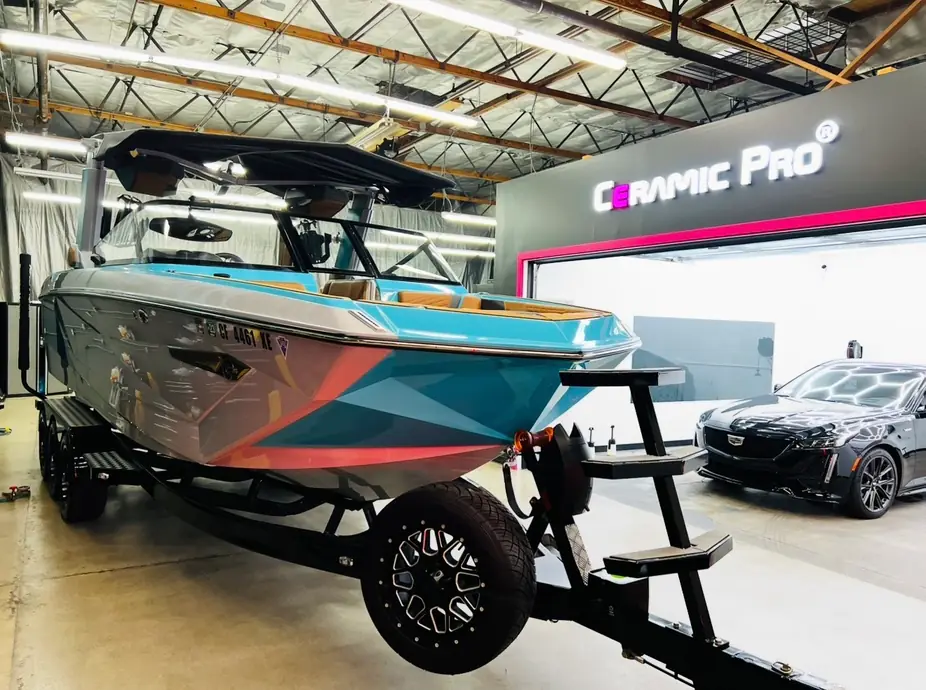
If you own a boat in Southern California, you have probably seen what sun and salt do to a hull. The color fades. The gloss goes flat. Run a hand along the side and your palm comes away with a chalky film. That is oxidation, and while it looks like a paint problem, it is really a gel coat problem. Understanding how it forms, and how it is corrected, will help you decide what your boat needs.
Platinum Plus Detailing in Costa Mesa works on boats as well as cars. A wake boat sitting inside the shop next to a Ceramic Pro wall is part of the business's own photo record, and the team's marine pages cover gel coat restoration for saltwater and UV damage.
What gel coat is and why it oxidizes
Most fiberglass boats are finished with gel coat, a pigmented resin layer that forms the outer skin of the hull. It is not paint, and it is not meant to be repainted regularly. It is a relatively thin layer that has to protect the fiberglass underneath for the life of the boat.
UV light breaks the surface of that resin down over time. Salt, wind and the heat of the sun speed things up. The result is a microscopically rough surface that scatters light instead of reflecting it, which is why oxidized gel coat looks dull and faded, and why darker colors show it first. The chalky residue you feel is the broken-down layer coming off on your hand.
Compound, polish, protect
Restoring oxidized gel coat follows the same order as correcting a car's paint. It begins with a wash and decontamination to remove surface contamination. Then comes compounding, which uses an abrasive to take off the oxidized layer and level out scratches. A compound cuts, so it leaves its own fine haze. Polishing is the second step, a finer abrasive that refines the surface and brings back clarity and gloss.
Platinum Plus describes its marine service as paint decontamination, a two-step compound and polish, and an interior vacuum, with a stated aim of 90 percent or better defect removal. The two steps are not optional extras. Compounding alone leaves the surface hazy. Polishing alone does not touch deep oxidation.
The third step is protection, and it matters more than most owners expect. Gel coat is thin, and every correction removes a little material. You cannot keep compounding a hull forever. Once the surface is restored, you want it to stay that way, which is where a marine ceramic coating comes in.
Bravo vs Marine
Platinum Plus applies two Ceramic Pro products to boats. Both include the decontamination, the two-step compound and polish, and the interior vacuum. They differ in the coating and the warranty.
- Ceramic Pro Bravo: starts at $95 per linear foot, carries an 18-month warranty, and has a turnaround of 1 to 2 days.
- Ceramic Pro Marine: starts at $175 per linear foot, carries a 3-year warranty, and has a turnaround of 3 to 5 days.
The longer turnaround on Marine reflects a longer job. The choice comes down to how the boat lives. A boat stored on a trailer or under cover and used on weekends has a different set of demands than one that sits on a slip in saltwater, in the sun, all year. If your boat is in the second group, the longer-warranty Marine coating is worth discussing. If you want strong results at a lower starting price, Bravo is the lower-cost option. Final pricing depends on the length of the boat, since it is quoted per linear foot, and on the condition of the gel coat.
What to ask before you book
Ask how bad the oxidation is, and whether a single compound step will be enough or the team expects to work harder in certain areas. Ask which coating suits how you use the boat. Ask how long the boat will be in the shop, because the two coatings run on different timelines. And ask what you should do afterward to keep the finish looking its best, including how to wash it.
Rinsing a boat with fresh water after time on the water helps, because salt left to dry on a hull is part of what accelerates the damage. A soft mitt and a gentle wash go a long way, and the same principles that keep a coated car looking good apply on the water.
Other big surfaces
Boats are not the only large surface that benefits from this kind of work. Platinum Plus also offers ceramic coating for RVs, with pricing starting at $200 per foot for the full exterior of a motorhome. If you own both, mention it when you call, and the team can quote the work together.
See the boat buffing and ceramic coating service for the current packages, or call (714) 614-1691 with your boat's length and a description of what you see on the hull.
Platinum Plus Detailing, (714) 614-1691
Call (714) 614-1691More articles
Ceramic coating vs paint protection film: what each one does for your paint
Coating and film protect paint in different ways, and knowing the difference makes any quote easier to read.
How to wash a ceramic-coated car so the coating keeps working
A good wash routine is the cheapest way to keep a coating looking and behaving the way it did on day one.